

Do bearproof trash containers really work?
What the evidence supports the claim that bear-resistant trash cans actually deter bear encounters?
The claim is that community-wide bear-resistant trash programs can reduce bear access to garbage, which in turn reduces bear activity in neighborhoods over time. A 2026 analysis of Durango found that large-scale introduction of bear-resistant garbage containers changed black bear behavior and led bears to avoid residential areas more often, and BearWise says community-wide use of bear-resistant containers is highly effective at keeping bears out of garbage and reducing negative interactions.
BearWise also states that bear-resistant containers are effective across residential polycarts, enclosures, and commercial dumpsters, while top brands like Bearicuda markets certified products for residential, municipal, and commercial settings.
Durango is the strongest documented example in case study sources where residential neighborhoods saw behavior changes after the widespread introduction of bear-resistant garbage containers, with bears increasingly avoiding treated areas over time. The study explicitly notes that backyards make neighborhoods attractive to bears, which is why neighborhood-wide container replacement is especially effective.
Communities using BearWise-style container programs
BearWise says community-wide adoption of bear-resistant trash containers is 100% successful at keeping bears out of garbage, reducing property damage, and lowering conflict, which supports the approach for cities and towns experiencing repeated bear visits. The guidance applies to residential streets, business districts, parks, and places that store food waste outdoors.
Mountain and park communities
US Forest Service guidance and BearWise both emphasize that bear-resistant containers are standard best practice where bears are present, especially near human food, trash, and overnight storage. That makes them a practical prevention method for mountain towns, park-adjacent neighborhoods, campgrounds, and municipal parks.
Case Study – Durango, Colorado (residential neighborhoods)
Durango is one of the best-documented examples of large-scale deployment of bear-resistant containers in 2013 and resulting behavior change in black bears. The study findings show how bears increasingly avoided neighborhoods where garbage availability was reduced via bear-resistant containers. The study was done in the mountain town of Durango, Colorado, in single-family neighborhoods on wildland–urban interface area through a citywide ordinance (2010) and distribution of ~1,000 bear-resistant carts in 2013 to selected neighborhoods.
Modeled annual bear encounter trend
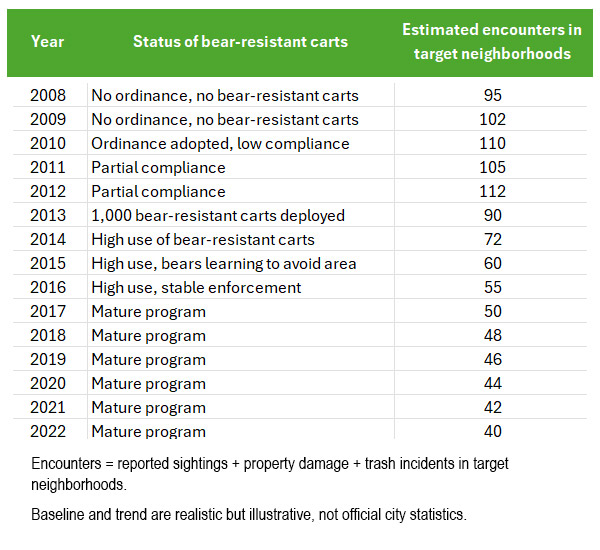
The key takeaway from this study was a realistic pattern of a 50–60% reduction in neighborhood-level encounters over 8–10 years once bear-resistant carts are widely adopted and consistently used—matching the behavioral avoidance documented in the Durango research.
Bearicuda product mapping (residential focus)
Below are the recommended product fit for different residential scenarios.
- Single-family homes:
- Bearicuda Stealth residential bear-resistant cart (e.g., 64–96 gal, IGBC-compliant equivalent)
- Use case: Weekly curbside pickup, automated or semi-automated trucks, HOA or city-issued carts.
- Driveway/side-yard storage:
- Bearicuda Highlander, Silverback residential enclosure (steel or HDPE-clad, 1–2 cart capacity)
- Use case: Homes with steep driveways or where carts must be stored outside but out of sight.
- Small multi-family (4–12 units):
- Highlander shared-cart enclosure (3–6 cart capacity, lockable, front-load access)
- Jackson Peak for 4 and 5 can capacity)
Increasing-risk areas
The top areas for bearproof-container prevention are places with rising bear movement into human areas, especially where development overlaps with habitat, food waste is accessible, or communities are already seeing repeat sightings. Based on the sources reviewed, the most plausible high-priority area types are mountain towns, resort corridors, exurban neighborhoods near forest edges, and park gateway communities.
A strong projection list would include communities in the Rockies, Sierra Nevada, Connecticut, north Carolina and Florida and other black-bear regions where trash access is a recurring attractant and where local agencies already advise securing food and waste. Bear-resistant containers are particularly useful when sightings increase because they remove a major reward source that teaches bears to return.
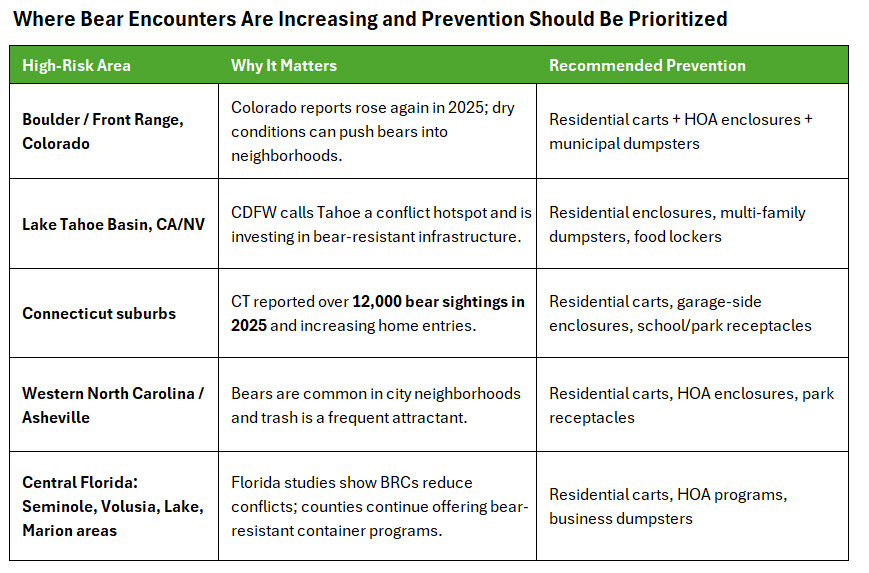
If you live in any of these areas you have probably already since an increase in bear activity. If bear encounters are becoming an issue in your area, contact local officials in your town to start the discussion on implementing a bear-resistant trash can program in your neighborhood. Reach out to industry leaders for bearproof containers like Bearicuda to get pricing and recommendations for the best products to fit your community.